Module 51, Pediatric Orthopaedist Level

This patient is a 12 year old male who initially presented
with a history of left knee pain for 4 months. He denied any obvious
history of trauma. He claimed to play a lot of basketball and
felt that the pain was worse after playing. The patient also claimed
to have a "knot" over the anterior aspect of his proximal
tibia. On physical examination the patient had a prominent tibial
tubercle which was warm, swollen, and tender. The knee did not
have an effusion, and there was no joint line tenderness. There
was also no tenderness over the patellar tendon. There was full
range of motion in the knee, but the patient had hamstring tightness.
He also had pain with resisted knee extension. There was no instability
to varus or valgus stress. McMurray test was negative. Lachman
test was negative. Patellar tracking was normal, and there was
no pain with loading of the patellofemoral joint. X-ray of the
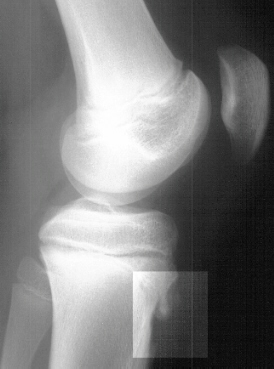
left knee revealed an ossicle anterior to the tibial tuberosity.
Patient was diagnosed with Osgood-Schlatter disease and told to
refrain from playing ball for 4 weeks. He was also given a prescription
for Motrin. The patient continued to play and returned complaining
of increased pain and tenderness at the tibial tuberosity.
Question 51A

 Placing
the boy in a knee cylinder cast would have removed his symptoms
faster and more completely.
Placing
the boy in a knee cylinder cast would have removed his symptoms
faster and more completely.
Question 51B
The
blood supply only enters the apophysis of the tibia from the medial
side and this condition is probably an avascular necrosis of the
apophysis.
Question 51C
The
diagnosis may not be Osgood-Sclatter disease because there are
no symptoms in the other knee and this condition is usually bilateral.
Question 51D
Tendonitis
is an important aspect in the symptoms of this condition.
Question 51E
Fragmentation
of tibial tubercle may be seen as a normal variation in ossification
and is not by it self diagnostic of Osgood Schlatter.
Go to Next Question Module, Go to General Orthopaedist Level Modules,
Go to Question Module Home Page,
Go to Case Presentation Home Page,
Orthopaedic Department Home Page.