
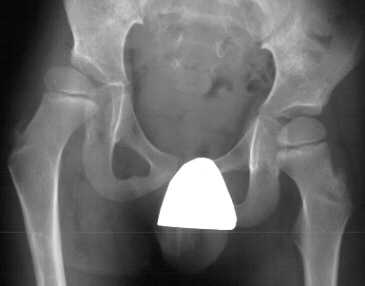
This male was born premature and was in the hospital for 3-1/2 weeks. He started walking by cruising at 18 months. He is now 7 years old and walking using his crutches and a walker. He uses a combination of the bilateral Lofstrand crutches, a K-posture walker and a light-weight wheelchair depending on the distance that he has to ambulate. He is in a regular class room and has normal speech. In the last year his ambulation has become more difficult because of toe dragging and his feet rolling over. The PT evaluation reveals good knee range of motion with very mild hyperextension of the knees bilaterally. There is mild to moderate spasticity of the rectus femoris, left greater than right. There is also mild spasticity in bilateral adductors and iliopsoas. Gross motor functional testing in standing revealed poor function. He is able to stand independently for 1 - 2 seconds. He was not able to rise from the floor through a half kneeling position, even with assistance of the upper extremities. He uses hand support to rise from a chair or lower to the floor. His parents report poor tolerance for orthotics presently; he complains significantly of pain while wearing orthotics.
KNEE

                PROM/STRENGTH                   MUSCLE TONE/MOTOR CONTROL
                        R       L                         R       L
        Knee ext        0-4     0-3             Rectus    2       3
        Knee flex       0-135   0-135
                                                FLEXIBILITY
                                                Pop angle 45      50
                                                Ely test  125     120


FUNCTIONAL STRENGTH
Independent standing:  1-2 sec.
One leg stance:  <3 sec. on both legs
Short sit to stand:  only with both hands
Lowers to floor:  with hands controlled
Standing-picks pen from floor:  with hands (turning to side)

Examination of his hips demonstrates adequate flexion. He is really quite weak throughout. His knee extension and flexion is full. He has very little ability for any independent motor control in any of his lower extremities.

  HIP

               PROM/STRENGTH         MUSCLE TONE/MOTOR CONTROL
                     R       L                  R        L

        Hip flex     115     120     Iliop      -        -
                     3       3                  -        -
        Hip abd(ext) 10      15      Glut med   -        -
                     -       -       Adductor   2        2
        Hip ext      20      20                 +/-      +/-
                     -        -      Glut max   +/-      +/-
        Int rot      25       25
        Ext rot      5        40     FLEXIBILITY
                                     Thomas T   15       20
                                     Ober T     -        -


 KNEE

               PROM/STRENGTH         MUSCLE TONE/MOTOR CONTROL
                      R       L                    R       L

        Knee ext      0       0       Quads        -       -
                      4+      4+      Rectus T     3       3
        Knee flex     130     130     Hamstring    0       0
                      2-       2-                  -       -
                                      Knee jerk    3+      3+
                                      Ankle jerk   1+      1+


                                      FLEXIBILITY
                                      Pop angle    40 (35) 40(30)
                                      Ely test     120     120


ANKLE

                PROM/STRENGTH         MUSCLE TONE/MOTOR CONTROL
                      R       L                   R        L

        Dorsi (flex)  10      11      Ant tib     -        -
                      2+      2+      Gastroc     1        1
              (ext)   1       5                   -        -
        Plantar       50      45      Soleus      -        -
                      -       -       Post tib    0        0
        Inv           25      20                  -        -
                      -       -       Peroneals   -        -
        Ever          25      45
                      -       -
                                      Babinski    -        -
        TFA           20 ext  25 ext  Clonus   sustained sustained
On the kinematic evaluation the pelvis is rotated posterior on the right
by 20 degrees. The hip on the right is internally rotated 25 degrees and
the left hip is externally rotated 20 degrees. Peak knee flexion in swing
phase is to 35 degrees and the EMG of the rectus is constantly on in swing
phase and off in stance phase. Foot contact knee flexion is 20 degrees
and hamstring EMG timing is normal. Ankle dorsiflexion is to 10 degrees
in stance and only to neutral at toe off.

 The
treatment must address both the ambulatory difficulties and the subluxated
hip.
The
treatment must address both the ambulatory difficulties and the subluxated
hip.
The
pelvic rotation present on the kinematic evaluation can be corrected with
a correctly performed reconstruction of the hips.
The
planovalgus foot correction should be done at the same time as the hip
reconstruction. It is very important to make sure the alignment of the
feet is not in significant internal or external rotation relative to the
knee joint.
A
distal hamstring lengthening and a distal rectus transfer should also be
performed to improve knee kinematics.
You
can confidently reassure the parents that the surgical reconstruction (hips,
knees and feet) will have a low risk of decreasing the child's ambulatory
ability.
Go to Next Question Module, Go to General Orthopaedist Level Modules, Go to Question Module Home Page, Go to Case Presentation Home Page, Orthopaedic Department Home .