Module 56, Pediatric Orthopaedist Level

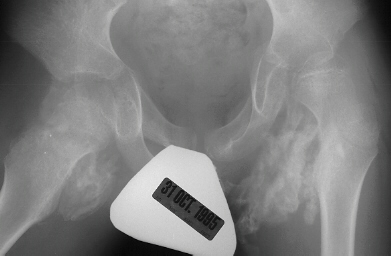
A nine year old male with a diagnosis of spastic quadriplegic,
cerebral palsy presented for a follow-up exam. This patient was
non-ambulatory and non-verbal. Patient had good head control and
was capable of sitting if propped up. The patient had bilateral
release of iliopsoas, gracilis, adductor longus, distal hamstrings
and right tensor facia lata release 4 weeks prior to this examination.
Now, the patient still required valium and analgesics due to pain
and muscle spasms. At this time a firm mass was palpated in the
left groin. The whole groin was warm to touch and the child was
reported to have intermittent temperature elevation to 38.5 degrees.
He appetite was also diminished. Two months post op the patient
was still having pain. Four months post op the patient was more
comfortable but still having pain with motion at (the end of his
range) 90 degrees flexion, -30 degrees extension, 20 degrees of
abduction and no rotation.
Question 56A

 Manipulation
under anesthesia should now be considered to improve range of
motion (ROM).
Manipulation
under anesthesia should now be considered to improve range of
motion (ROM).
Question 56B
This
child should have been placed on indomethicin at the first suggestion
that a heterotopic ossification (HO) was forming.
Question 56C
Although
alkaline phosphatase is initially elevated, 2 to 3 months after
surgery this child's alkaline phosphatase should be back to near
normal.
Question 56D
Heterotopic
ossification which forms after hip surgery in children with Cerebral
Palsy usually requires surgical excision followed by radiation
treatment.
Question 56E
Heterotopic
ossification occurs more commonly in children with CP in the area
of the iliopsoas or when hip surgery is done in close temporal
proximity to spinal surgery.
Go to Next Question Module, Go to General Orthopaedist Level Modules,
Go to Question Module Home Page,
Go to Case Presentation Home Page,
Orthopaedic Department Home Page.